

![[Section Divider Image]](https://substackcdn.com/image/fetch/$s_!idGy!,f_auto,q_auto:good,fl_progressive:steep/https%3A%2F%2Fsubstack-post-media.s3.amazonaws.com%2Fpublic%2Fimages%2Fc5bf3f9c-481f-4aab-8f1b-2caa93363574_1320x50.webp "[Section Divider Image]")
You had a long conversation this week with someone you respect.
Someone who thinks differently than you do about the most important geopolitical question in markets right now...and who landed in a different place than you did after turning it over from every angle he could find.
His name is John Butler. He writes The Amphora Report on Substack. You’ve been friends for years. You were both in Cape Town a month ago when the shooting started. You’ve been comparing notes ever since. And last week, when you finally sat down to work through it, you came to different conclusions about who actually wins if the Strait of Hormuz stays contested.
Your position, laid out in prior work: the United States is the most insulated major economy in a prolonged Hormuz disruption. Largest crude producer. Largest LNG exporter. Heavy crude refinery infrastructure on the Gulf Coast engineered for Western Hemisphere supply. That insulation is structural, not situational.
Butler’s position: Russia is the most insulated. And when he walked you through it, you had to admit...his case is strong enough that you cannot dismiss it. The question isn’t which of you is wrong. The question is what happens if you’re both right.
It’s not that the US thesis fails. It’s that the story has two beneficiaries on a relative basis, not one. And the bigger of the two is the one almost nobody is talking about.
Step back. Think about what’s actually at stake here...and what the debate reveals about how the rest of the world gets hit.
What the Iran Debate Actually Agrees On
Before you get to where Butler and you disagree, consider what you don’t.
You both agree the Gulf is the single best example of a free-rider economy since the Second World War. These are countries that had almost nothing at the end of that war. The United States made them rich in exchange for freedom of navigation, regional deterrence, and dollar-denominated oil sales. That arrangement worked for seventy years. It isn’t working now.
You both agree Iran has spent two decades building parallel infrastructure. The Russia-Iran twenty-year strategic partnership signed three days before Trump’s second inauguration was not a rhetorical gesture. It was the formalization of a relationship the two countries had been deepening while Washington was busy in Iraq and Afghanistan. You both agree China has been buying Iranian crude at a 10 to 15% discount for years because nobody else will, which means Iran’s entire export economy is effectively a single-client operation.
You both agree the United States has genuinely shifted its strategic priorities back toward the Western Hemisphere. The national security posture is clear. The Venezuela operation was not theater...it was energy positioning. The Colombia reversal, the Mexico cooperation, the critical mineral work across Latin America...these are all of a piece.
And you both agree there is a plan. You may not like the plan. You may have concerns about whether the people executing it understand what they are stepping into. But the idea that there is no plan...that the Pentagon walked into this without contingency work for a prolonged disruption...is just silly. Declining hegemons do not improvise at this scale.
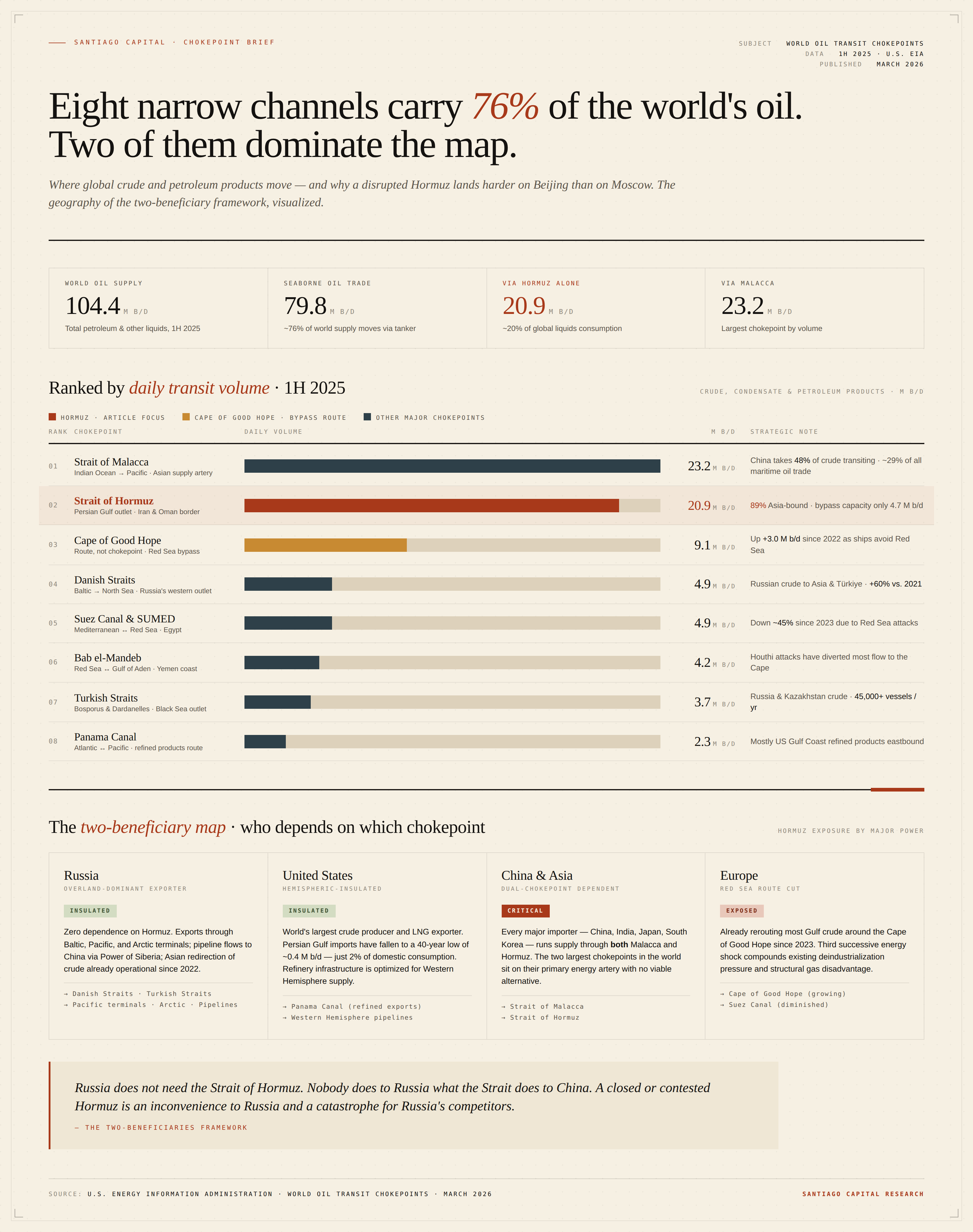
What you disagree on is who comes out ahead on the other side.
Why Russia Benefits From a Prolonged Strait of Hormuz Crisis
Butler’s case starts with geography. And geography, in the end, is destiny.


