

![[Section Divider Image]](https://substackcdn.com/image/fetch/$s_!zJGZ!,f_auto,q_auto:good,fl_progressive:steep/https%3A%2F%2Fsubstack-post-media.s3.amazonaws.com%2Fpublic%2Fimages%2F858536b3-6e34-42fa-a9f2-58478841c254_1320x50.webp "[Section Divider Image]")
There’s a split happening inside a lot of serious macro thinkers right now, and most of them won’t say it out loud.
It’s not a split about the data. The data is what it is. It’s not a split about the framework either. If you’ve been paying attention, the framework is holding. Dollar strengthening under global stress. Capital concentrating in the Imperial core. Energy weaponized as an explicit instrument of great-power competition. National security replacing price efficiency as the primary organizing principle of industrial policy. The structural thesis is not in question.
The split is something else. It’s the tension between what you know is happening...and what you wish were happening instead.
Call it conviction versus confliction.
Most people in this business pretend the two don’t coexist. They present their frameworks with the affect of a machine: coldly logical, morally unencumbered, comfortable in their certainty. But if you’ve been genuinely absorbing what’s unfolding right now...not just pattern-matching to a trade thesis but actually sitting with what it means for the world...you’re probably not as comfortable as you’re letting on.
The United States is conducting military operations across the Middle East. Roughly 50,000 U.S. troops are already stationed in the region under Operation Epic Fury, with thousands of additional Marines and 82nd Airborne paratroopers now moving toward the Persian Gulf. The Pentagon is actively preparing ground operation plans. The Strait of Hormuz is contested.
There is a plan. You may not like it. The strategic logic doesn’t particularly care whether you do. But denying its existence is itself an analytical error, and analytical errors have portfolio consequences.
That is what conviction feels like right now: clarity about the logic, discomfort about the cost.
And that discomfort is not a bug in your thinking. It’s a signal that you’re still paying attention to the full picture.
The Libertarian and the Realist: Why Both Are Right
Here’s where the confliction starts for anyone who has genuinely thought through first principles.
The libertarian tradition, which is where a lot of clear-eyed market thinkers start, holds that individuals are the fundamental unit of moral concern. That voluntary exchange produces better outcomes than coercion. That concentrated power is dangerous by design, which is precisely why the institutions of the Rules-Based Order were built to contain it. That war is, even in success, a form of failure...because of what it costs to get there.
That is a coherent framework. It it packs moral gravitas.
But realpolitik, which is the other tradition you have to reckon with honestly, tells you something different. States act in their own interest. Moral language covers for strategic maneuvering. Power vacuums always get filled. Geography, resources, and demographics shape outcomes more reliably than ideology and good intentions. And the great-power competition between major powers never truly ends...it just goes into hibernation between cycles.
It’s not that the libertarian framework is wrong. It’s that it describes the world as it should be. Realpolitik describes the world as it is.
Winston Churchill said it more precisely than most:
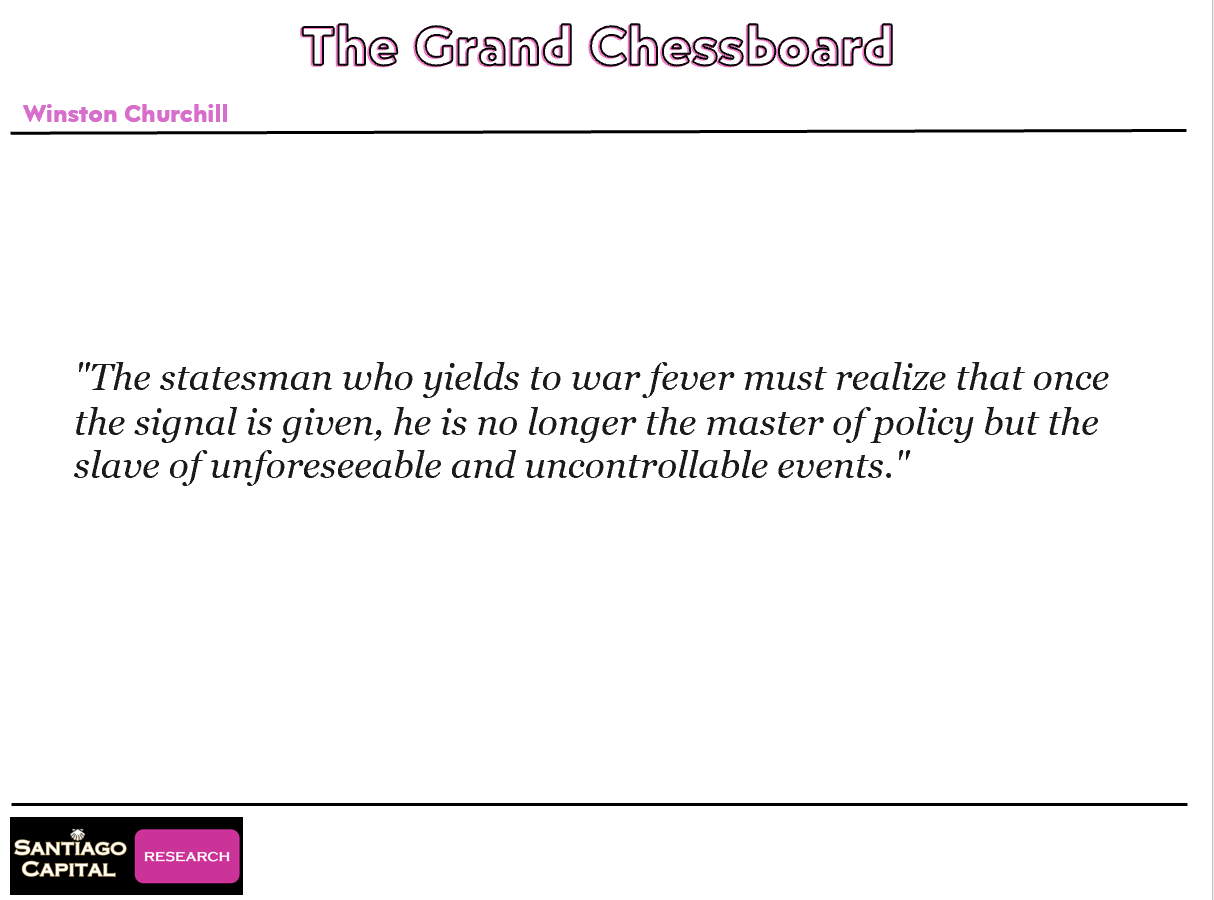
That is not an endorsement of war. It is an acknowledgment that once a certain threshold is crossed, the logic of events takes over. You can understand that logic without endorsing where it leads.
You can hold both of those things at once. The idealism tells you what matters. The realism tells you what is. The goal is not to pick one. The goal is to use each as a check on the other. Idealism without realism is naive. Realism without idealism tips into nihilism. Neither extreme serves you, as an investor or as a human being.
The most honest and objective analysis of what’s happening right now requires you to feel both the intellectual logic of it and the moral weight of it...and to refuse to look away from either. Let’s dig in.
The Hardest Trade You’ll Ever Make
Here’s the practical consequence of all of this, and it’s the part most commentary on geopolitics never quite gets to.


