

![[Section Divider Image]](https://substackcdn.com/image/fetch/$s_!JVHx!,f_auto,q_auto:good,fl_progressive:steep/https%3A%2F%2Fsubstack-post-media.s3.amazonaws.com%2Fpublic%2Fimages%2Fd5c779f0-f3f2-46fd-8c5a-7f8d804f422e_1320x50.webp "[Section Divider Image]")
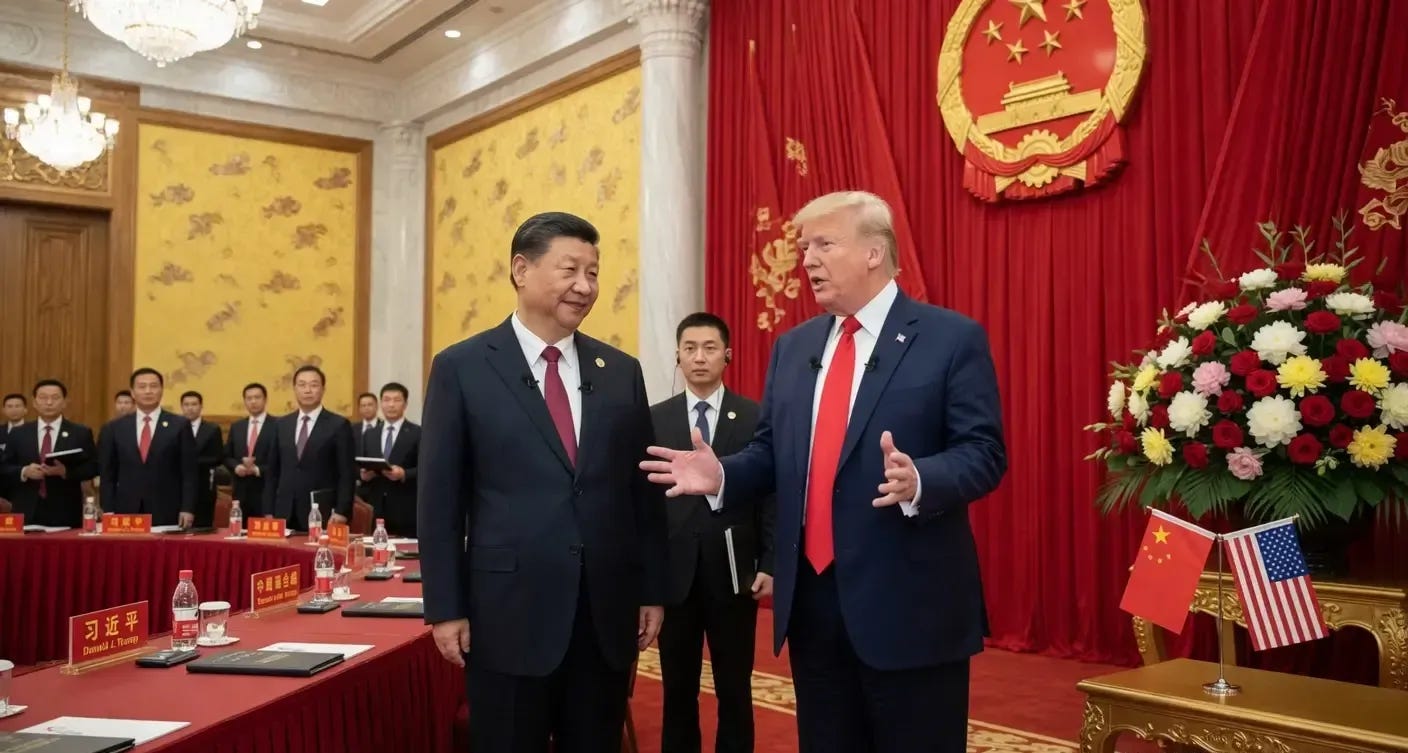
The opening move at the Beijing summit last week wasn’t about tariffs.
It wasn’t about Taiwan. It wasn’t about fentanyl or trade deficits or the renminbi. Chairman Xi took the floor first in the Great Hall of the People and asked a single question:
“Can China and the United States overcome the so-called ‘Thucydides Trap’ and create a new paradigm of major-country relations?”
That question is not neutral. It is not diplomatic small talk. It is a frame. And once you understand the frame, the entire relationship looks different.
The Thucydides Trap and What the Historical Record Actually Shows
The term comes from Graham Allison, a professor at Harvard’s Kennedy School. Allison built his framework on the work of Thucydides, the Athenian historian and general who lived through the Peloponnesian War in the fifth century BC. Thucydides’ core observation: it was the rise of Athens and the fear that this instilled in Sparta that made war inevitable.
Allison updated the analysis. He examined 16 cases over 500 years in which a rising power threatened an established dominant one. Twelve of the sixteen ended in war.

Allison is not a peripheral figure. He was one of the founding deans of the Harvard Kennedy School, a former assistant secretary of defense under Clinton, and a senior advisor to Reagan’s Secretary of Defense during the height of the Cold War. His book Destined for War: Can America and China Escape Thucydides’s Trap? laid out the evidence chain roughly a decade ago.
What makes Xi’s invocation significant is the sourcing. A Chinese Communist Party chairman, in his opening remarks at a bilateral summit with the United States president, is referencing a Harvard professor’s analytical framework to set the tone for the entire meeting. Think about what that means.
Xi’s Red Line: What the Framework Was Really Saying in Beijing
There is something else happening in that opening statement that is easy to miss.
In this analogy, the roles are unambiguous. China is the ascending power. The United States is the established dominant one. For Xi to raise this framework in that room is to tell Trump, without saying it directly: you need to allow us to grow, because if this relationship is mismanaged, the historical pattern says we both lose.
He used Taiwan as the concrete illustration. Xi told Trump that the two countries “could collide or even come into conflict” if the Taiwan issue is mishandled. That is a red line delivered in the language of historical scholarship rather than the language of ultimatum, which makes it harder to dismiss and harder to call aggressive.
This is the art of the framework as a diplomatic instrument. Xi is not threatening war. He is pointing to a centuries-old pattern and asking whether both sides are smart enough to escape it. The polite framing does not soften the underlying content.


