

![[Section Divider Image]](https://substackcdn.com/image/fetch/$s_!YvWE!,f_auto,q_auto:good,fl_progressive:steep/https%3A%2F%2Fsubstack-post-media.s3.amazonaws.com%2Fpublic%2Fimages%2F86ab329e-4eb3-49b8-87b5-8f391140c6dc_1320x50.webp "[Section Divider Image]")
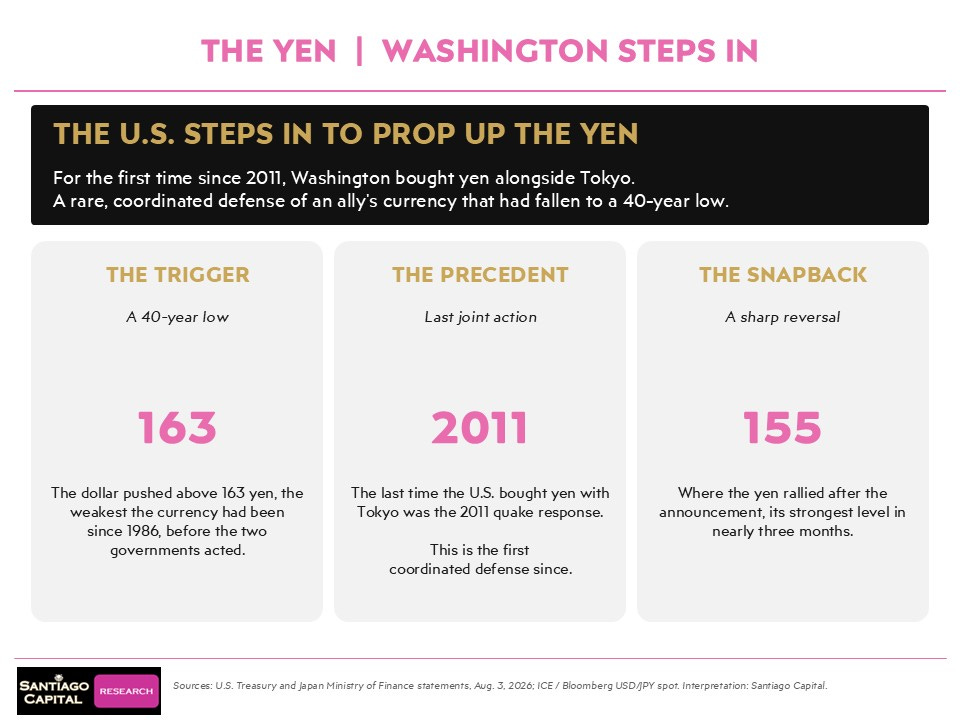
On the last day of July, the U.S. Treasury sold euros to buy Japanese yen.
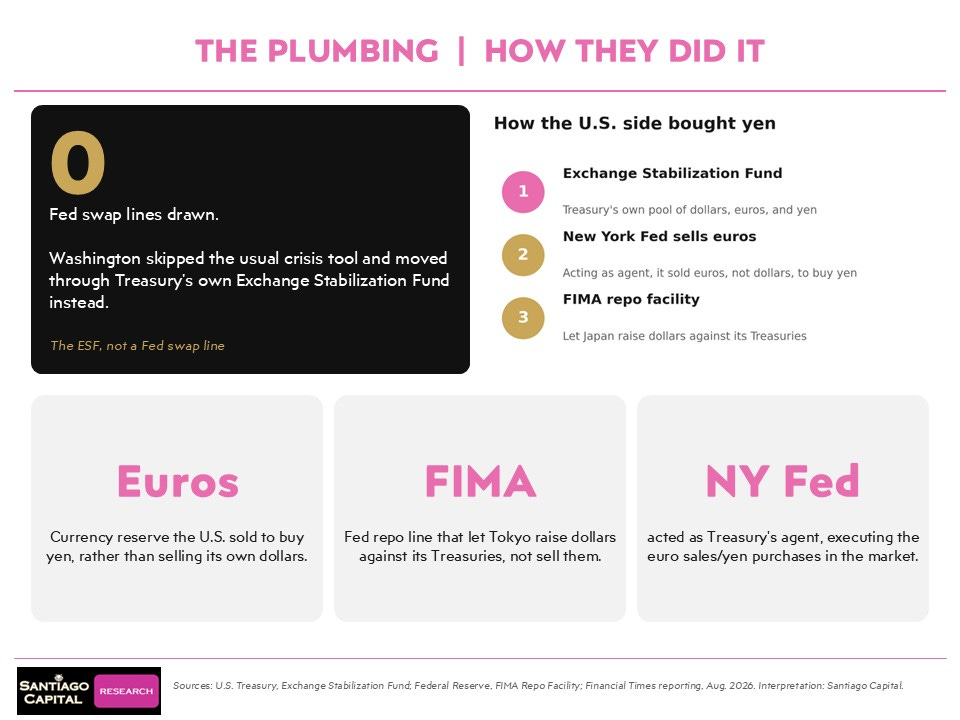
Read that sentence again, because almost every word in it is unusual. Not dollars. Euros. Not the Federal Reserve acting on its own account. The Treasury, through the Exchange Stabilization Fund, with the New York Fed executing as its agent. Not a swap line, which is the tool built for exactly this situation and which has been sitting there fully authorized the entire time. And not in defense of the dollar, but in defense of somebody else’s currency.
The yen went from a forty-year low near 163 to roughly 155 within days, a move of about 5% in a week. For a currency that trades trillions a day, that is an earthquake. Japan’s Ministry of Finance is estimated to have spent close to $59 billion. The U.S. side, judging from a to-do list photographed on Treasury Secretary Scott Bessent’s notepad at a July 31 Cabinet meeting, spent somewhere around $10 billion. Tokyo and Washington confirmed the joint action on August 3, and both said the same thing in slightly different words: we will not hesitate to do this again.
You know what happened next. Within an hour, everyone had a take. The dollar system is breaking. The Fed is bailing out Japan. Washington has lost control. The end is here, and it is here this week.
Step back. Almost none of that is what happened.
What the U.S. Treasury Actually Did to the Yen
The Exchange Stabilization Fund is the Treasury’s own pool of currencies. Dollars, euros, yen. Created in 1934, it exists precisely so the Treasury can act in foreign exchange markets without asking the Federal Reserve for anything. The Fed is the Treasury’s bank, so the New York desk does the execution, but the decision and the money were Bessent’s.
The unusual part is what the Treasury sold. It did not print dollars and it did not spend dollars. It sold euros out of its own reserves and used the proceeds to buy yen. The U.S. also opened the door to the Fed’s FIMA repo facility, which lets a foreign central bank pledge its U.S. Treasury holdings for dollars instead of selling them into the market. Bessent has since called the facility “an important backstop” and pushed publicly for it to be upsized in the coming months.
Hold that thought. It is the whole article.
Then there is the part that cost nothing at all. Bessent went on the record saying Washington had acted and would act again. Japan’s Finance Ministry said it would not hesitate to intervene jointly a second time. President Trump, asked about it, said Japan wanted a little help and America is always there for Japan.
The euros were the smaller weapon. The promise is the bigger one, and it is free. A finite pile of euros is something the market can count and test. A credible statement from the institution that issues the world’s reserve currency is something the market has to price without ever knowing the size of the ammunition. If you are short the yen with leverage and the yen moves eight big figures against you in a week, you do not get to be right later. You get carried out now. Shorting a currency Washington has publicly vowed to defend is a specific kind of dangerous, and the market understood that immediately.
The tactical question has an easy answer. Washington jawboned, spent about ten billion dollars of somebody else’s currency, and moved a market worth trillions.
The strategic question is the one worth your time. Why does the United States care what the yen does? Why did the Treasury do this rather than the Fed, and why through a mechanism that required Washington to spend its own reserves instead of a facility that would have cost it nothing?
The answer is not in Tokyo.
Below this line: why Washington deliberately skipped the swap lines and what that choice signals to Europe, the 165 level that four decades of chart history says is the last line of defense, the specific size of Japan’s Treasury position and what a forced sale would do to the yield every bond on earth is priced against, and why this rescue was never charity.
The euros were the small part of the story. The reason Washington spent them is the large part.
→ Go beyond the paywall to read the full post. Thanks for reading.


