

War in the Middle East. Political dysfunction at home. Crazy valuations on an unproven technology. Gas heading toward five dollars a gallon. And still the market will not crash.
You have watched this for years. The list of reasons it should break gets longer every quarter, and every quarter it holds. Plenty of smart people have stood up and said this cannot go on. They have been right about the risks and wrong about the outcome, and being right about the risks has not helped them one bit.
So the question is not whether the risks are real. They are. The question is what keeps bidding anyway. Because something is bidding, mechanically, without regard for any of the news you are reading. Name that thing and you have a real edge. You start to see what would actually have to break for the tape to break, instead of waiting on a headline that never quite does the job.
Here is what holds the market up. And here is the part almost nobody says out loud: the same machinery that holds it up is what will eventually take it down.
![[Section Divider Image]](https://substackcdn.com/image/fetch/$s_!XsJq!,f_auto,q_auto:good,fl_progressive:steep/https%3A%2F%2Fsubstack-post-media.s3.amazonaws.com%2Fpublic%2Fimages%2F82985e35-df10-442b-ae55-c6fa82a1a6d8_1320x50.webp "[Section Divider Image]")
The rise of passive management is the eternal bid
Start with the biggest one. The rise of passive management.
You have heard us reference our friend Mike Green on this. If you do not know his work, stop reading us and go read him, because he built the framework and it reshaped how we think about the whole tape. The core of it is simple. The passive machine does not think. It gets cash, it buys. It is asked for cash, it sells. It does not read the balance sheet, it does not care what the management team is doing, and it never asks the price. It is the simplest algorithm in market history, and it is price-insensitive by design.
That last phrase is the whole thing. A buyer that does not care about price will pay any price, and higher prices can pull in still higher prices. The bid feeds on itself.
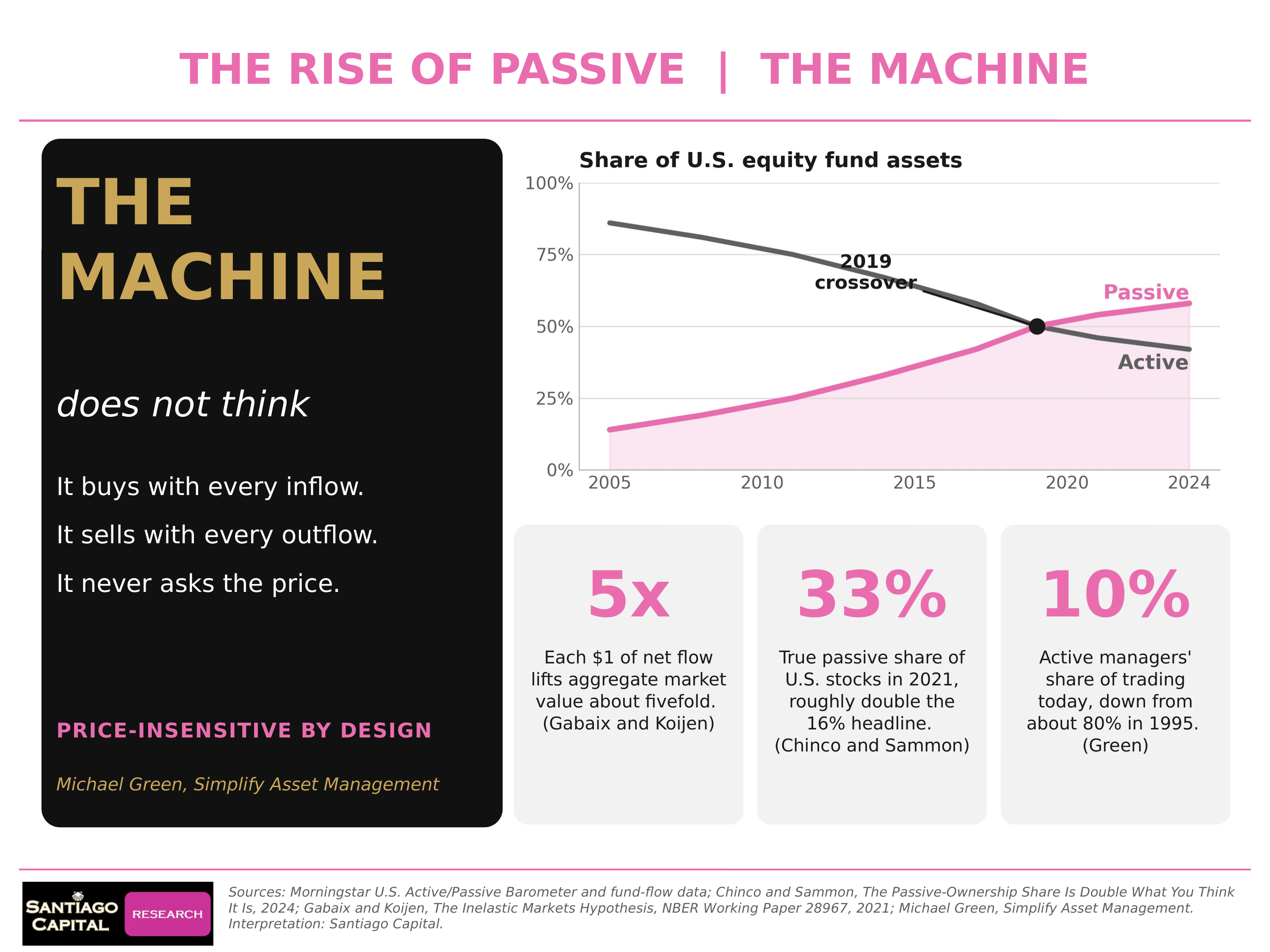
This is not a fringe corner anymore. Twenty years ago passive was under twenty percent of equity fund assets and active was the overwhelming majority. That relationship has flipped. Passive crossed above active around 2019 and now sits above half of all fund assets. The buyers who once held cash and hunted bargains are a shrinking share of the tape.
Make no mistake about what that does. It does not mean the market only goes up. It means that when it sells off, a mechanical buyer is waiting on the other side of every paycheck, which is why recent drawdowns have recovered faster than the fundamentals alone would suggest. The bid is automatic, swept in on autopilot no matter what prices are doing.
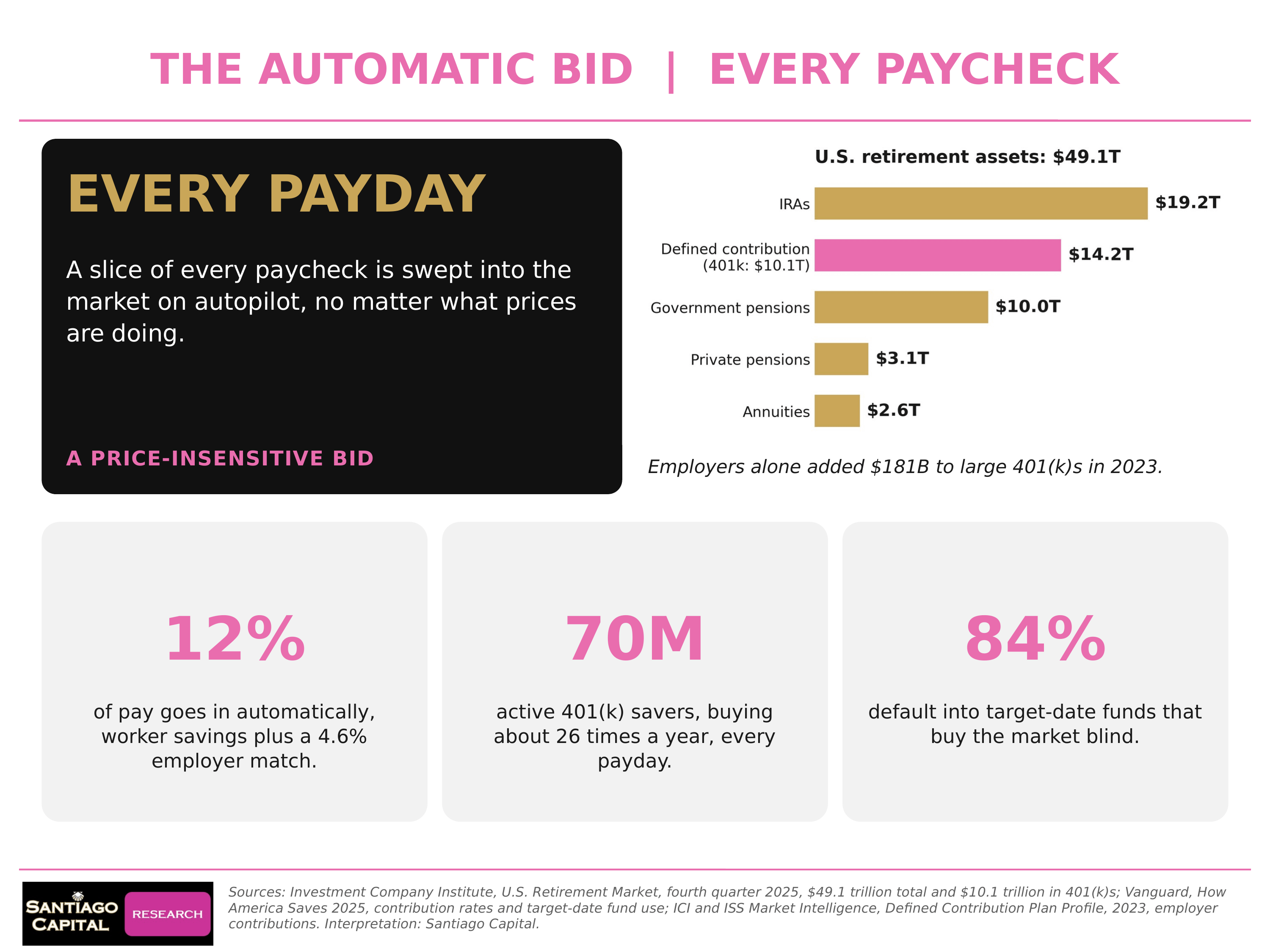
Roughly seventy million people hold an active 401(k), most contributions default straight into target-date funds, and those funds buy the market blind. Retirement assets in this country run near forty-nine trillion dollars. Every payday, a portion of it goes in, no questions asked. As long as people are employed, that steady bid is simply there.
That is the engine. It explains a great deal of why the thing will not break on schedule. But an engine that runs one direction can run the other, and the reason is buried in the same mechanism that makes it feel so safe.
Here is where it gets dangerous.


