
Y'all Street
Wall Street's oldest insult has become a forecast. If the financial capital ever leaves New York, it does not sail to Shanghai. It goes to Texas.

![[Section Divider Image]](https://substackcdn.com/image/fetch/$s_!ZhKc!,f_auto,q_auto:good,fl_progressive:steep/https%3A%2F%2Fsubstack-post-media.s3.amazonaws.com%2Fpublic%2Fimages%2F8fae0711-3913-46c7-8f4a-075a110fb100_1320x50.webp "[Section Divider Image]")
On July 6, 2026, the Texas Stock Exchange opened its order book.
Two hundred and seventy five million dollars of backing. A roster that includes BlackRock and Citadel Securities. A tower in Uptown Dallas. It is the most heavily funded challenge the New York Stock Exchange and Nasdaq have faced in a generation, and it is not even the most interesting thing that happened in that zip code this year.
Now hold that next to a sentence from 1989.
When Michael Lewis published Liar’s Poker, he folded in a line every trading floor understood instantly. The lowest fate that could befall a young trainee, the assignment muttered about and dreaded, was to be sent off to sell equities in Dallas. Equities, because bonds were where the money and the status lived. Dallas, because Dallas was the far edge of the map, the posting you were exiled to once New York and London were finished with you.
To sell equities in Dallas was to have failed twice in the same three words.
Read that line in 2026 and it does not land as an insult. It reads as a real estate tip you are thirty years late to act on.
Why Wall Street Is Moving to Texas and Not Shanghai
You know the fear by now, because the industry has been quietly bracing for it for years. The fear is that the crown eventually crosses an ocean, that a rising China or a reserve hungry Europe pulls the center of financial gravity out of the United States entirely, and that the American century ends with a wire transfer.
That fear is aimed at the wrong horizon.
The center is moving. It is not leaving the country. It is moving roughly fifteen hundred miles to the southwest, to a state that now runs the eighth largest economy on the planet and did not ask Wall Street for permission to build it.
If you have followed this publication, you already have the framework. We have argued for years, through the Dollar Milkshake and the Eurodollar plumbing beneath it, that the United States holds its position not because the world admires it but because the structure of the dollar system leaves the world no exit. In The Backyard we mapped the hemisphere rewiring in real time. In The Circular Bailout we watched the Treasury demonstrate in public exactly how little exit there is.
Follow that one step further than almost anyone bothers to and it carries a physical consequence. If the capital of capital stays on American soil, the only open question is which stretch of American soil.
The evidence has been piling up in one state.
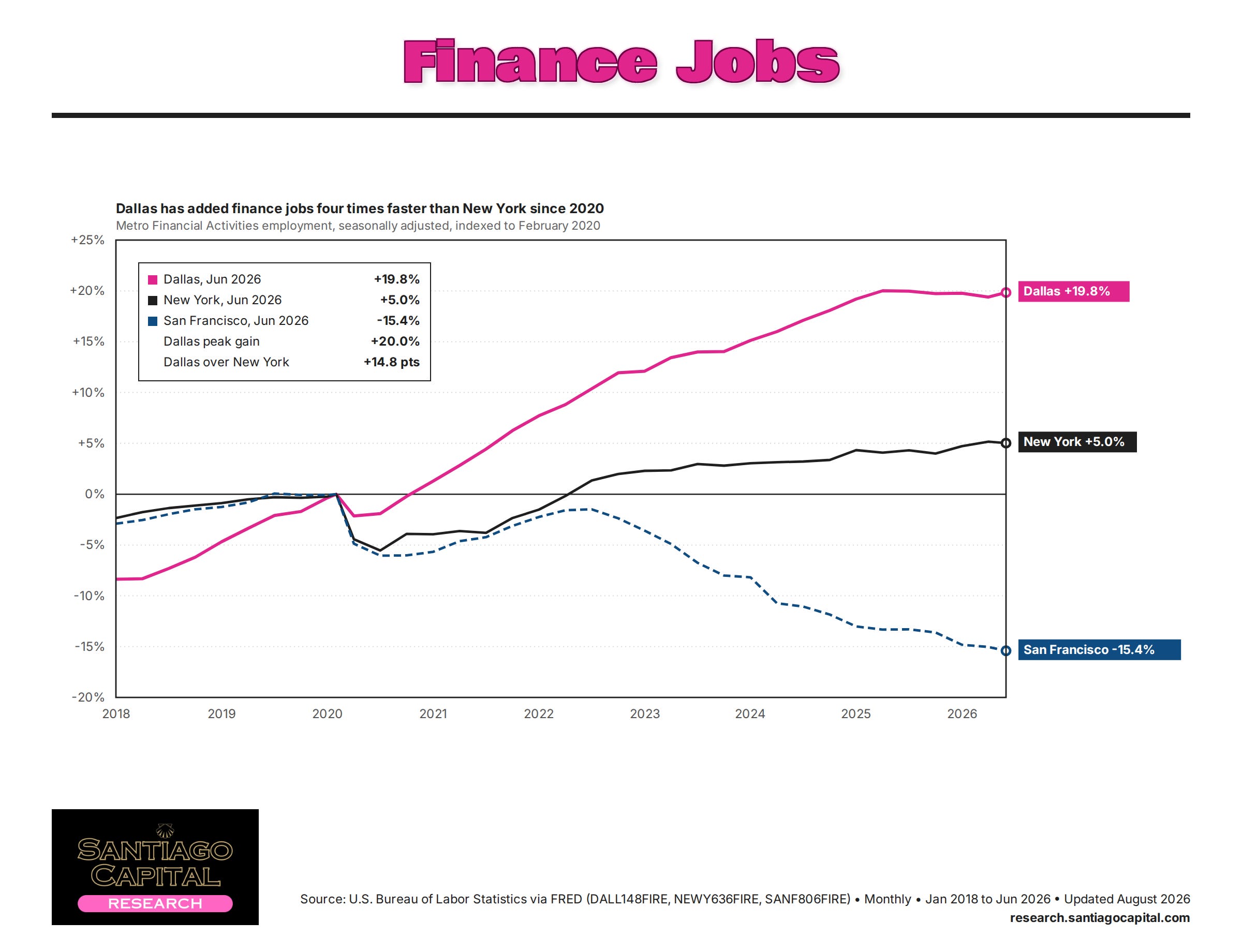
...a leading indicator of regional economic strength. Dallas stands out dramatically: it has added nearly 20% more finance jobs since 2020, growing four times faster than New York's modest 5% gain. San Francisco tells the opposite story, shedding 15.4% of its finance jobs over the same period...a steep and worsening decline. The gap between Dallas and New York now stands at 14.8 percentage points, reflecting a major shift in where the finance industry is putting down roots.
The Energy Moat Under Y’all Street
Everything downstream in this argument, the banks and the people and the exchanges, sits on top of energy, and energy is the one contest the United States has already won.
In 2008 the country pulled about five million barrels of crude out of the ground each day and imported the difference from places that did not always wish it well. In April of 2026 it produced 13.97 million barrels a day, the highest monthly figure any nation has ever recorded, and it sold the surplus abroad.
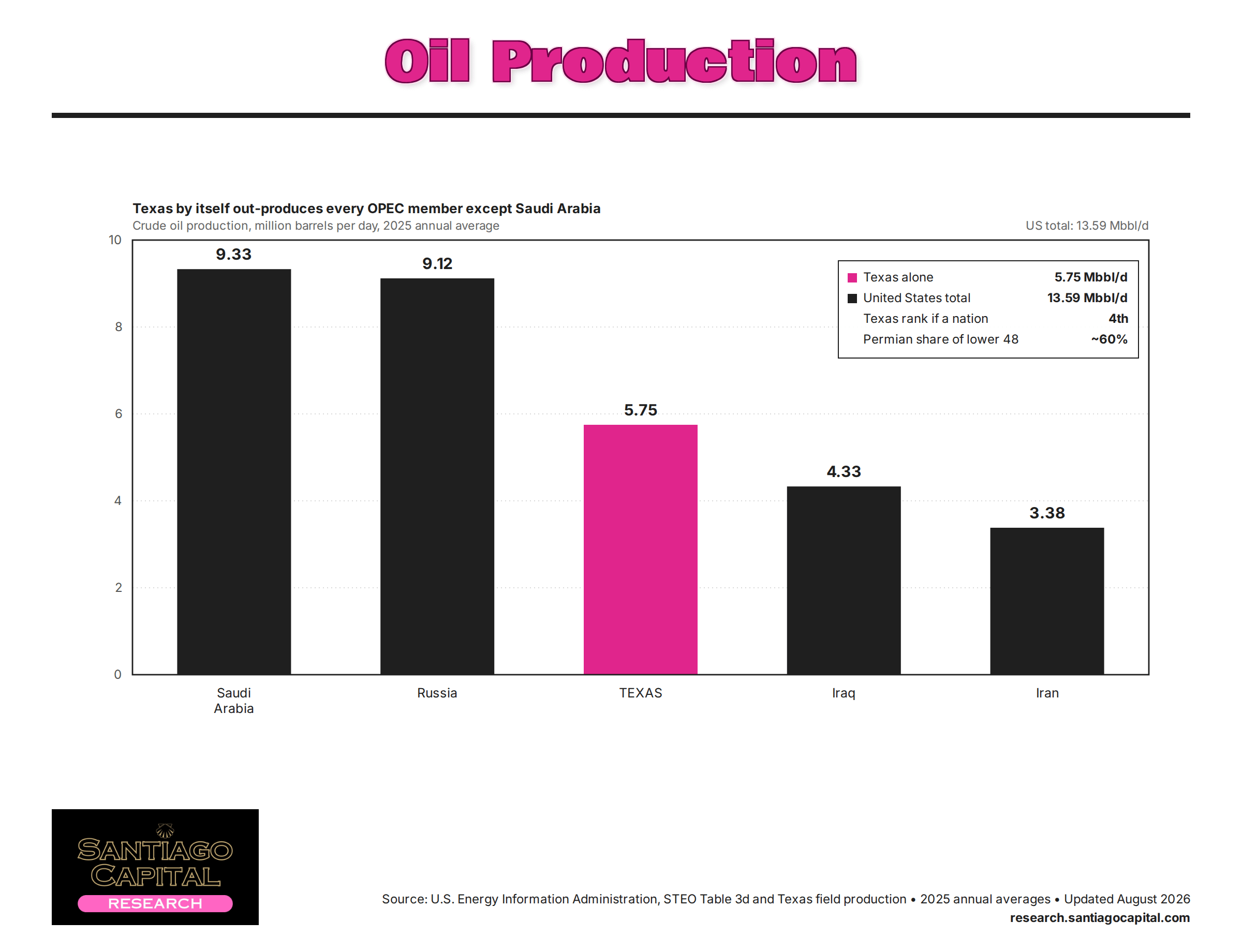
Texas by itself pumps close to 5.8 million barrels a day. Treated as a sovereign country it would rank fourth on earth, behind only the United States, Russia and Saudi Arabia, and ahead of every member of OPEC but the Saudis.
Through 2025 and into 2026 a run of Gulf disruptions pushed crude above a hundred dollars a barrel and reminded every importer that Middle Eastern supply cannot be counted on from one quarter to the next. For a country that must buy its oil abroad, that is a vulnerability. For the United States it is the reverse. The same shock that raises costs everywhere else raises the worth of what Texas already holds in the ground.
An advantage that shelters you while it strains your rivals has stopped being an advantage. It is a moat.
And finance follows the real economy. The data centers, the reshored factories, the industrial base a great power needs for a long contest, all of it moves toward the place where power is abundant and the grid is not somebody else’s decision to make.
Y’all Street Is No Longer a Joke. It Is Brick and Headcount.
The exchanges make the headlines. The buildings are the commitment.
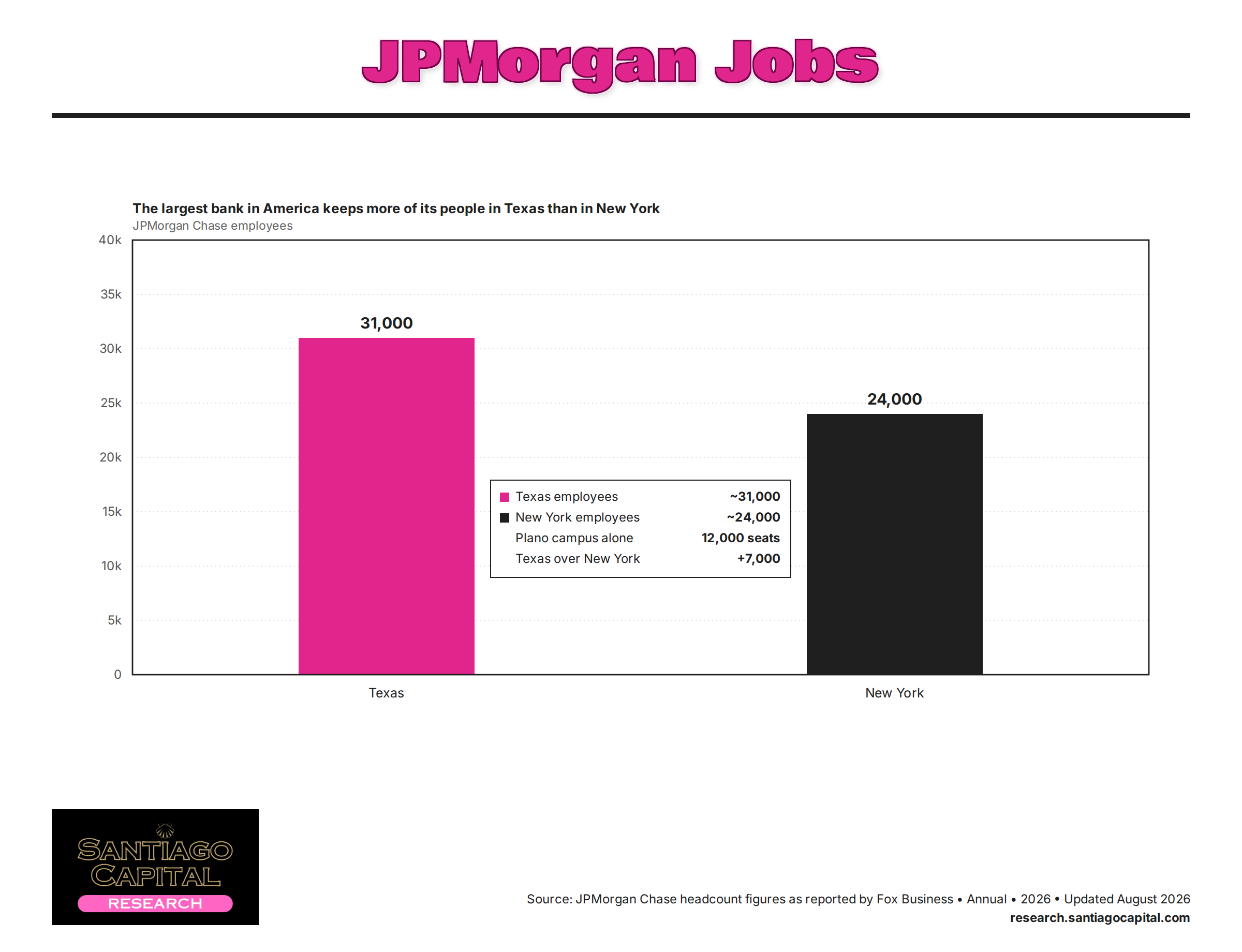
JPMorgan Chase now employs roughly 31,000 people in Texas against the 24,000 it keeps in New York, with 12,000 of them on a single campus in Plano. Read that again. The largest bank in the United States has more workers in Texas than in the city whose name is a synonym for banking.
Goldman Sachs is pouring roughly 500 million dollars into an 800,000 square foot campus in Victory Park, built for more than 5,000 people, and Dallas is already its second largest hub in the country. Bank of America is putting up a thirty story tower. Charles Schwab did not expand into Texas, it moved to Texas. Scotiabank, out of a banking system famous for doing nothing quickly, is opening a regional headquarters in the same Dallas district as Goldman.
You do not have to believe Texas is the future to notice that Goldman just spent 500 million dollars betting that it is.
And almost none of it is finished. These are not firms consolidating into space they had outgrown. They are firms building more capacity than they need, on purpose.
The Migration Carries Income, Not Just People
Underneath all of it sits the migration.
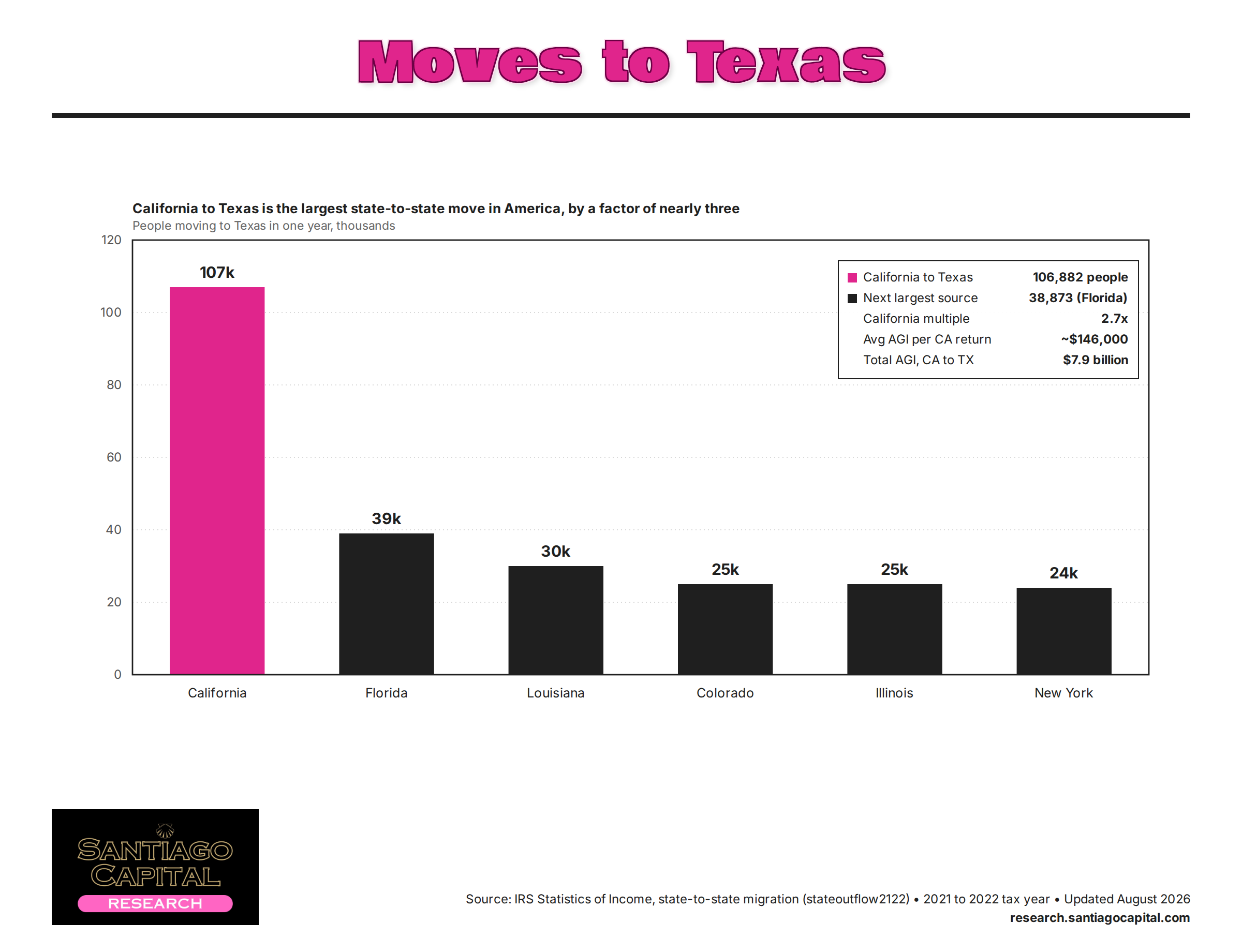
Texas reached 31.7 million residents by the middle of 2025, adding more people that year than any other state. The single largest state to state move in America is California to Texas, and it leads the next largest source by a factor of nearly three.
The part that matters is who. According to the IRS, the households leaving California for Texas carried an average adjusted gross income of roughly 146,000 dollars, and close to eight billion dollars of income in total. The state is not simply gaining residents. It is gaining earners, and income does not stay behind when a person leaves.
The Texas Bullion Depository Is the Tell
A financial capital has never been only a place where money is traded. It has always also been a place where reserves are physically kept. London and New York became what they are in part because the gold sat in their vaults.
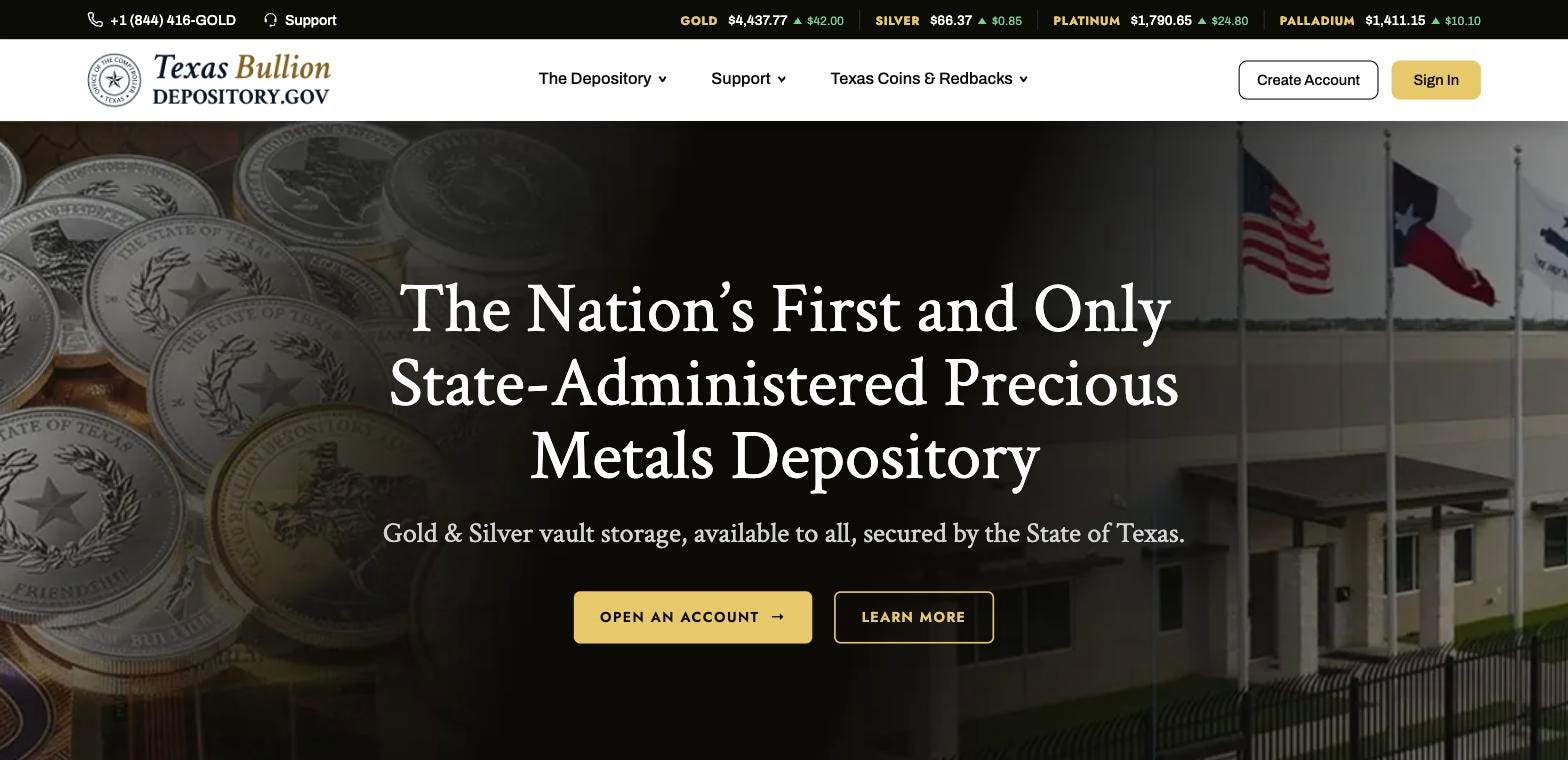
In 2015 Texas created its own bullion depository, the first state administered precious metals depository anywhere in the country, and it takes deposits from individuals, from businesses and from financial institutions. The statute goes further than that. It expressly contemplates dealings with central banks and sovereign wealth funds, inside or outside the United States.
The motive was not only symbolic. The University of Texas endowment was holding roughly 660 million dollars of gold bars in an HSBC vault in New York and paying storage fees by the bar, and Texas wanted somewhere to bring metal like that home.
That is the thesis in miniature. Not that the gold has already moved, because the law compels nobody to move it, but that a state went and built the place to put it.
What Equities in Dallas Covers
The article above gives you the shape of the argument. It does not give you the evidence chain, and it does not give you the case against.
What this teaser does not cover, and what our latest pro report, Equities in Dallas does:
All five forces built out with the data behind each: energy, migration, the Wall Street buildout, the culture capital reads as a line item, and the raw physical room to grow
Geographic sovereignty, the Prisoners of Geography frame turned inside out, including Laredo as the busiest land port in the hemisphere and why a Canadian bank plants its American flag in Dallas rather than New York
A full chapter on Why Not Beijing, laying out why the same dollar structure that keeps the center in America is the precise reason it does not cross the Pacific
The case against ourselves: water, the grid, and the real depth of the Texas talent bench, conceded as readily as the advantages are claimed
What the shift means for positioning, and the discipline of a forecast that refuses to staple a date to itself
It is not that the China thesis is wrong about ambition. It is wrong about plumbing, and plumbing is what moves money.
None of this is frictionless. Texas has a water shortfall its own state plan projects will widen by sixty percent by 2080, and a grid whose peak demand is set to nearly double by 2032, and the report gives those constraints a chapter rather than a footnote. We are not claiming New York falls. New York does not fall, and nothing here needs it to. We are claiming that if the financial capital of the world ever does leave New York, the combined weight of these forces means it does not sail abroad.
The move is not a forecast waiting for a starting gun. It is already underway, led by the people who tend to be right first.
The insult held for thirty years.
It does not hold anymore.
→ Read Equities in Dallas

Santiago Capital is a registered investment advisor. The content above is for informational and educational purposes only. It is not investment advice, a recommendation, or a solicitation to buy or sell any security. Past performance is not indicative of future results. Consult your own financial advisor before making investment decisions.