
Think, Laugh, Cry #44
How DARK's Bootstrap Paradox reveals that nothing begins where you think it does.

![[Section Divider Image]](https://substackcdn.com/image/fetch/$s_!e4ZX!,f_auto,q_auto:good,fl_progressive:steep/https%3A%2F%2Fsubstack-post-media.s3.amazonaws.com%2Fpublic%2Fimages%2Fc9ee6494-7378-4771-8a49-0e4655411e38_1320x50.webp "[Section Divider Image]")
Think
Nothing begins where you think it does.
That is the quiet, unsettling premise at the heart of DARK, a German science fiction series on Netflix that I will tell you almost nothing about, because telling you almost nothing is the greatest gift I can give you.
What I will say is this: watch it.
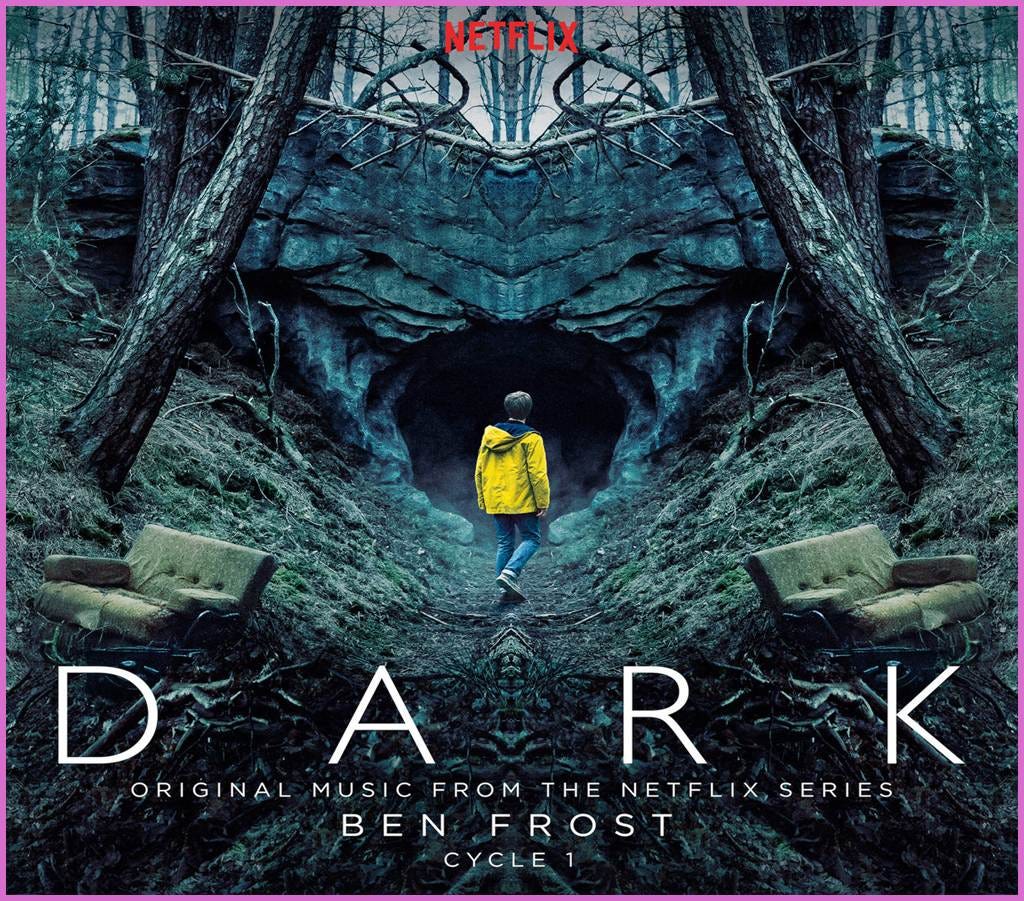
It is, in my opinion, a genuine masterpiece.
The writing is intricate without being pretentious. The cinematography is cold and beautiful. And the casting is one of the most remarkable achievements in the history of the medium.
Each character is portrayed at multiple points in their life by different actors, and the physical resemblance between the young, middle-aged and elderly versions of the same person is so precise it borders on eerie. You will find yourself pausing, rewinding, staring at a jawline or a pair of eyes, thinking: how did they find these people?
But I am not here to review the show. I am here because DARK introduced me to something called the Bootstrap Paradox, and once you see it, you cannot stop seeing it.
The paradox goes like this. Imagine a time traveler who goes back to the past and gives Beethoven the complete sheet music to his Fifth Symphony. Beethoven publishes it. It becomes one of the most celebrated compositions in human history. Centuries later, a time traveler finds the sheet music and carries it back in time to give to Beethoven. Here is the question the paradox asks, and it is a simple one: who wrote it?
Nobody did.
The music exists. It has always existed within the loop. But it has no author, no origin, no moment of creation. It is an effect that caused itself. Western thinking, which is built almost entirely on the assumption that every effect has a cause, has no answer for this.
The Bootstrap Paradox does not bend the rules of causality. It eliminates them.
And here is where things get uncomfortable, because the Bootstrap Paradox is no longer just a thought experiment for obsessive television viewers. It is happening right now, in the real world, in ways that should give all of us pause.
But before we get there, consider that some of the most serious scientific minds of our time have already been pulling at this same thread. Stephen Hawking and physicist James Hartle proposed that asking what existed before the Big Bang is not a question we lack the tools to answer. It is a question that has no answer because time itself has no edge.
There is no before. There is no starting gun.
Physicist Carlo Rovelli, in his book “The Order of Time,” goes further, arguing that the arrow of time, that deep intuitive sense we all have of moving forward from past to future, is a feature of human perception, not of physical reality. At the quantum level the equations work just as cleanly in reverse.
And then there is Rust Cohle, the detective played by Matthew McConaughey in True Detective, who put it in terms no physics journal ever quite managed: “Time is a flat circle. Everything we have ever done or will do, we will do over and over and over again.” Rust was channeling Nietzsche, who spent a lifetime arguing that time is not a line with a beginning and an end but a loop with neither.
In a strange way, the Bootstrap Paradox does not ask you to abandon logic. It asks you to question whether the linear, cause-and-effect framework you have been using your entire life is something the universe actually has, or something you brought to it yourself.
Now back to the real world.
Consider how artificial intelligence learns. Large language models are trained on vast amounts of text scraped from the internet. That text increasingly includes content generated by earlier versions of those same AI models. The output of one generation becomes the training data for the next. At some point, and researchers believe we are already past it, you can no longer identify a human origin for significant portions of what the AI knows, how it reasons, or how it speaks.
The information taught itself. The voice has no author. Nobody wrote the symphony.
The same loop shows up in the way information spreads and mutates across the internet. Consider one of the most repeated facts in casual conversation: that human beings only use ten percent of their brains.
Neuroscientists will tell you this is completely false. We use virtually all of our brain, and most of it nearly all of the time. But try to find who said it first. Researchers have spent careers chasing this question. Every candidate turns out to be a misquote or a misattribution that points to something earlier, which points to something earlier still, until the trail simply vanishes.
There is no origin. The myth exists because people repeated it. They repeated it because they heard it. They heard it because people repeated it. It is its own author.
It bootstrapped itself into truth.
And then there is cinema. Darth Vader does not say “Luke, I am your father.” The actual line, in the actual film, is “No, I am your father.” But the misquote has been repeated in so many films, commercials, impressions and casual conversations that it has effectively replaced the original in collective memory. If you looked up the correct line right now it would feel like the mistake. The wrong version is more real to more people than the right one. Nobody decided this. It decided itself, one repetition at a time, each one making the next more likely, until the copy outgrew the source and became the only version most people know.
No author. No origin. An effect that caused itself.
Which brings me back to where we started. Scroll up and read the opening sentence. It been sitting there since before you knew anything about time travel or Beethoven or AI or Darth Vader.
But here is the thing. You could not have understood what that sentence actually meant until you reached this moment. The sentence required the essay to give it meaning. The essay required the sentence to give it a beginning. Each one is the cause of the other. Neither one came first.
You cannot find the origin because there is no origin. There is only the loop.
You did not just read about the Bootstrap Paradox.
You were inside one…