
Think, Laugh, Cry #42
Three friends rediscover the lost art of honest disagreement in an age where speaking your mind has become too dangerous

![[Section Divider Image]](https://substackcdn.com/image/fetch/$s_!R-_p!,f_auto,q_auto:good,fl_progressive:steep/https%3A%2F%2Fsubstack-post-media.s3.amazonaws.com%2Fpublic%2Fimages%2F81373aa4-1674-414e-a275-3c81b4c84ef7_1320x50.webp "[Section Divider Image]")
Think
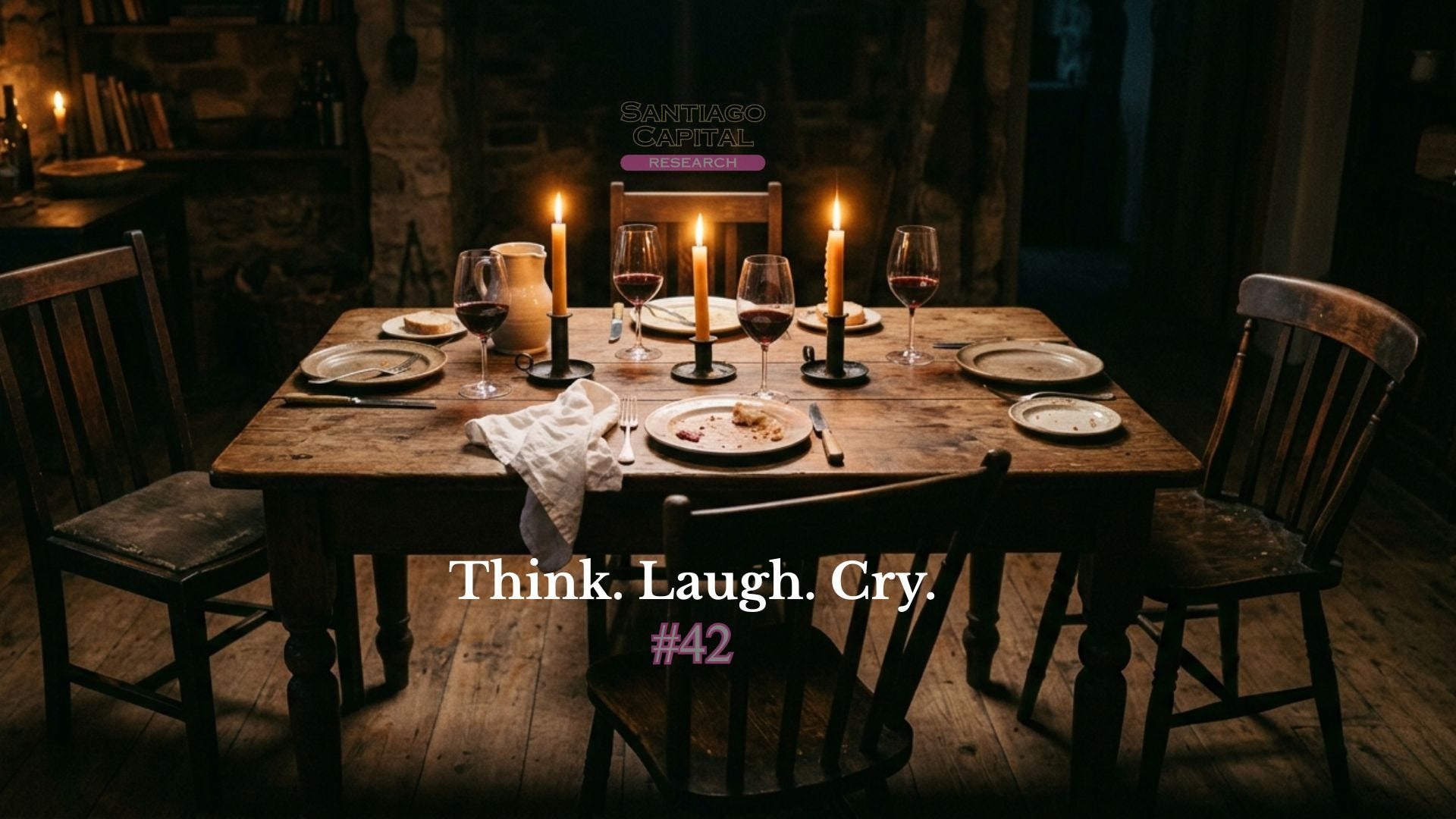
Once a month, the three of us sit down to dinner. We eat well. We drink a little. And then we argue.
Not argue the way social media argues. Not to perform, not to wound, not to win. We argue the way people used to argue when they actually cared about getting things right.
We go at monetary policy, geopolitics, Russia and Ukraine, the credibility of institutions, the reach of disinformation. We talk about Trump. We talk about Iran. We talk about the slow unraveling of things we once took for granted. We often do not agree. Sometimes we are loud about it. And at the end of the evening, we go home as friends, curious, sharpened, and genuinely glad the other two exist.
I have come to believe this is one of the rarest things in the world.
We live in an era that is allergic to disagreement. Not because people have stopped holding opinions (if anything, opinions have never been louder) but because the social cost of expressing the wrong one has become so high that most people have quietly stopped. They nod in the group chat. They like the post. They learn, slowly and without quite noticing, to say what keeps the peace rather than what they actually think.
The result is that most of us are surrounded by people we never really talk to.
What we have built, the three of us, is something different. The unspoken compact at our table is not that we will agree. It is that we will be honest. And there is a crucial distinction between those two things that most people never get around to discovering.
We feel no pressure to reach consensus. None of us loses face by changing our minds, and none of us loses face by holding our ground. But we would feel enormous pressure, real discomfort, a breach of something important, if either of the other two thought we were being dishonest. Or dismissive. Or cruel. The rule at the table is not agree with me. The rule is mean what you say and treat the other person as someone worthy of respect. Everything else is negotiable.
This turns out to be extraordinarily hard to find.
Most friendships, if we are honest, involve a quiet negotiation about which topics are safe. We learn the contours of each other’s sensitivities and route around them. This is not malicious. It is human, and it is kind, up to a point. But taken too far, it produces something hollow: relationships that feel warm but contain no real friction, and therefore no real growth. We mistake comfort for closeness, and we end up spending our most interesting intellectual hours alone.
The friends worth seeking out are the ones who will push back. Not to dominate you, but because they are genuinely interested in where you are wrong. They are curious about your reasoning rather than threatened by its conclusions. They have opinions they hold firmly and revise openly. They know the difference between “I disagree with your argument” and “I reject you as a person.” And they extend you the extraordinary grace of assuming you are trying to be right, even when they think you are failing at it.
There is also something to be said for the content of the disagreement.
The things we argue about, markets, geopolitics, the behavior of governments and central banks and populations under stress, are not trivial. These are the forces that shape lives. And the truth is that no one has a reliable model of how it all works. The world is too complicated. Which means the most valuable thing you can do, intellectually, is find people who have thought hard and arrived at different places, and make them defend it. Not to humiliate them. To understand something that your own mind, running in its own grooves, cannot generate alone.
This matters in any era. But it matters especially now, in a time of genuine uncertainty, when institutions are under pressure, when the information environment is polluted enough that no single source can be fully trusted, when the temptation to retreat into a tribe that confirms your priors is stronger than it has been in decades.
The authors William Strauss and Neil Howe wrote about the cyclical nature of historical crisis, periods when old orders give way and new ones have not yet formed. Whatever you think of that framework, the felt experience of this moment is familiar: things that seemed settled are unsettled. Confidence is expensive. And it is very easy to mistake the echo of your own voice for the sound of truth.
Against that backdrop, a monthly dinner where three people argue honestly about the world is not a small thing. It is a form of sanity maintenance. It keeps you humble, because you will lose arguments you were sure you would win. It keeps you honest, because these are people who will notice if you are bullshitting. And it keeps you connected to the most important truth of all: that the world is genuinely hard to understand, and that other serious people, reasoning carefully from the same basic facts, can arrive at genuinely different conclusions.
That last part sounds obvious. It is not.
Most of us have been quietly trained, by our feeds and our filters and our social circles, to experience disagreement as a sign that something has gone wrong. But the opposite is closer to the truth. Disagreement, handled with honesty and respect, is a sign that something has gone right. It means you are actually engaging with the complexity of the world rather than managing your exposure to it.
Find the people who will argue with you. Set a recurring dinner. Pick the hardest topics. Agree on nothing except the obligation to be honest and to stay kind. Then show up every month and see what you think.
The table where you can disagree without consequence is the one worth keeping.