
The Canary Just Sang. Are You Listening?
Private credit is flashing the same warning signs we’ve seen before every major credit crisis...and most investors still aren’t paying attention.



Something happened in February that you need to understand.
Blue Owl Capital...one of the largest private credit managers on the planet...permanently restricted withdrawals from one of its retail-focused debt funds. Not paused. Not delayed. Permanently restricted. Shares in Blue Owl fell nearly 6% on the news. And yet, within days, the mainstream financial press had moved on to the next story.
You shouldn’t.

Here’s the thing. Private credit has grown into a roughly $3 trillion global market on the back of a decade of near-zero interest rates, yield-starved investors, and banks retreating from lending due to post-2008 regulatory constraints. That growth attracted a massive wave of capital...and with it, every incentive to push the boundaries of prudent underwriting. When the environment is easy, you don’t see the risks. You only see the returns.
Now the environment is not easy. And the risks are starting to surface.
This is not cause for panic. But it is cause for a framework. And that’s exactly what we built.
The Growth Chart Doesn’t Lie...And Neither Does What Follows It
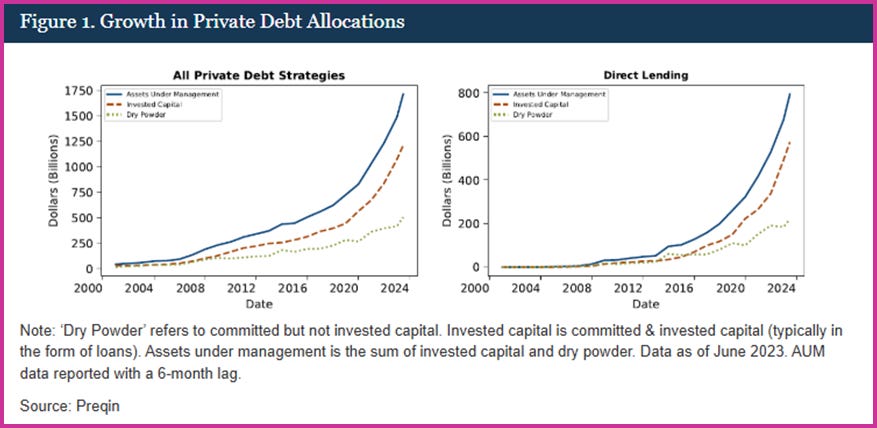
When you look at that chart, you see an asset class that has grown exponentially over two decades. Private debt strategies went from a niche corner of alternative finance to a multi-trillion-dollar market that now accounts for roughly 11% of U.S. GDP. That kind of growth is extraordinary.
It’s also a pattern you’ve seen before.
Subprime mortgages grew exponentially in the early 2000s. CDOs grew exponentially. So did the dot-com equity market before that. Rapid growth in any asset class is not inherently dangerous...but it creates the conditions for danger. Specifically, it attracts capital that wouldn’t otherwise be there, loosens underwriting standards as competition for deals intensifies, and embeds leverage at every level of the structure.
That’s what’s happening in private credit right now.
UBS recently warned that private credit default rates could surge as high as 15% in a worst-case scenario...revised upward from their already grim prior forecast. The reason for the revision? AI disruption risk. Around 40% of private credit loans are concentrated in the software and enterprise technology sector. If AI continues to hollow out software revenue models, a significant portion of the borrower base faces serious impairment.
That’s a structural risk sitting inside an already-stressed system.
The Five Patterns. They Always Reemerge.
Here’s what most people miss about credit crises: they’re not random. They follow patterns. The same mistakes, the same structures, the same incentives...repeated cycle after cycle because markets have short memories and the fees are good while it lasts.
We spent considerable time studying the failures...specifically, to understand what separates a resilient private credit fund from one that is quietly waiting to become the next cautionary tale. The methodology we used was Charlie Munger’s: invert, always invert. To understand strength, study collapse. The full case study breakdown is in our Pro-level report...but here’s what the evidence shows.

Five recurring failure patterns emerge. And you are watching all five play out in real time.
Leverage masks fragility. When you pile borrowed capital on top of illiquid assets and mark them internally...with no public market forcing price discovery...the leverage is invisible until it isn’t. Archegos Capital accumulated over $100 billion in synthetic equity exposure on $10 billion in actual capital. A 10-to-1 ratio. Nobody knew because total return swaps let them hide it across multiple prime brokers, none of whom had a complete picture of total exposure. When ViacomCBS fell and margin calls hit, Credit Suisse alone absorbed more than $5.5 billion in losses almost overnight. Hwang had quietly built a leveraged empire resting on a precarious foundation. Nobody saw it coming because the structure was designed not to be seen.
Illiquidity kills. This is the one that Blue Owl just demonstrated in real time. The fundamental problem private credit has always had is that the underlying assets are illiquid, but the vehicles sold to retail investors promise something approaching liquidity...quarterly redemptions, semi-liquid structures, and the like. When times are good, cashflows cover normal redemption requests. When times are bad, requests surge and it becomes a race to the bottom.
PeerStreet learned this lesson in 2023. The entire model...new loans, new investors, new capital...had to keep moving. Like a treadmill. The moment the Fed started hiking and the real estate market turned, the treadmill stopped. At its height the firm had originated over $1 billion in loans. By June 2023 it had filed for Chapter 11. It didn’t collapse because real estate was inherently risky. It collapsed because it built an entire business on the assumption that real estate would never be risky again.
Concentration risk is dangerous. It’s not that diversification is a novel concept...everyone knows you shouldn’t put all your eggs in one basket. But concentration risk is invisible in good times. Archegos was concentrated in a handful of media and tech names. The energy-sector direct lenders of 2014 to 2016 were concentrated in oil assumptions that turned out to be wrong by more than 70%.
Today’s private credit funds are heavily concentrated in software and tech. That’s where the AI disruption risk lives. It isn’t evenly distributed across the market...it’s clustered right where the capital went.
Short-term thinking leads to collapse. Medley Management is the case study here, and it’s worth sitting with. At its peak, Medley managed over $5 billion in assets. It presented itself as a disciplined middle-market lender. Underneath, it was a fee-extraction machine...inflating performance metrics and using new capital to meet obligations to earlier investors. The structure bore the hallmarks of a Ponzi scheme within its private credit funds. When fundraising slowed, the structure became unsustainable. By the time it filed for Chapter 11 in March 2021, it had stopped functioning as a private credit manager entirely.
Financial reality cannot be indefinitely deferred.
Misaligned incentives drive bad behavior. When fund managers are paid for deploying capital...not for long-term performance...reckless lending follows. The fees get extracted. The losses get socialized. This is not a conspiracy. It’s just the math of incentive structures. When AUM growth is the primary revenue driver, the priority is raising capital, not protecting it. Medley’s management extracted substantial fees even as the firm deteriorated. That’s not an anomaly. It’s a predictable consequence of how the incentives were set.
The Zombie Problem Is Bigger Than You Think
There’s a cohort of companies currently lurking inside private credit portfolios that aren’t really businesses. They’re refinancing cycles that happen to have employees.
These are the zombies...firms kept alive by a decade of ultra-low rates, rolling their debt perpetually because they could never generate enough cash to actually repay it. The assumption was that cheap money was permanent. It wasn’t.
As rates rose dramatically post-2022, many of these companies found themselves unable to service their obligations. Payment-in-kind usage has risen notably in private credit, with public BDCs now receiving an average of 8% of investment income via PIK...meaning borrowers are paying interest with more debt instead of cash. That’s a signal. When a borrower can’t pay interest in cash, the credit has already deteriorated. You’re just not seeing it in the official default statistics yet.
And that’s the other thing you need to understand: private credit operates without the same regulatory oversight as the largest banks. There will be less warning when distress arrives. The 2008 crisis played out in public markets where stress signals were visible in real time. Private credit operates behind closed doors with proprietary valuations. The DOJ has already publicly warned about “creative” marks and divergent valuation practices in private portfolios.
Jamie Dimon warned that private credit risks were hiding in plain sight...and that when you find one cockroach, more are usually nearby.
He’s not wrong. So what is actually at stake? Let’s find out.

