
The AI Supply Chain Just Hit Absolute Scarcity
Markets priced three Iran supply shocks. They missed the fourth. Why the helium shortage just broke the AI, semiconductor, and MRI supply chains.

![[Section Divider Image]](https://substackcdn.com/image/fetch/$s_!cuFv!,f_auto,q_auto:good,fl_progressive:steep/https%3A%2F%2Fsubstack-post-media.s3.amazonaws.com%2Fpublic%2Fimages%2F8e0b9afc-e4b7-498c-b82e-da41a22e3abb_1320x50.webp "[Section Divider Image]")
The Iran conflict triggered four simultaneous supply shocks.
Markets priced oil. They priced LNG. They eventually got around to pricing fertilizer, roughly a month after the ships stopped moving. The fourth shock, the one that will likely matter most over the next three to five years, got almost no coverage at all.
Helium.
You know the pattern by now. When markets fixate on the visible shock and miss the invisible one, the invisible one is always where the money is. And when the invisible shock happens to be in a material with no substitute for the industries that define 21st century economic and military power...semiconductors, MRI scanners, quantum computers, aerospace, defense...the implications are not the kind that resolve on diplomatic timelines.
Step back. Think about what’s actually being said right now...and more importantly, what isn’t.
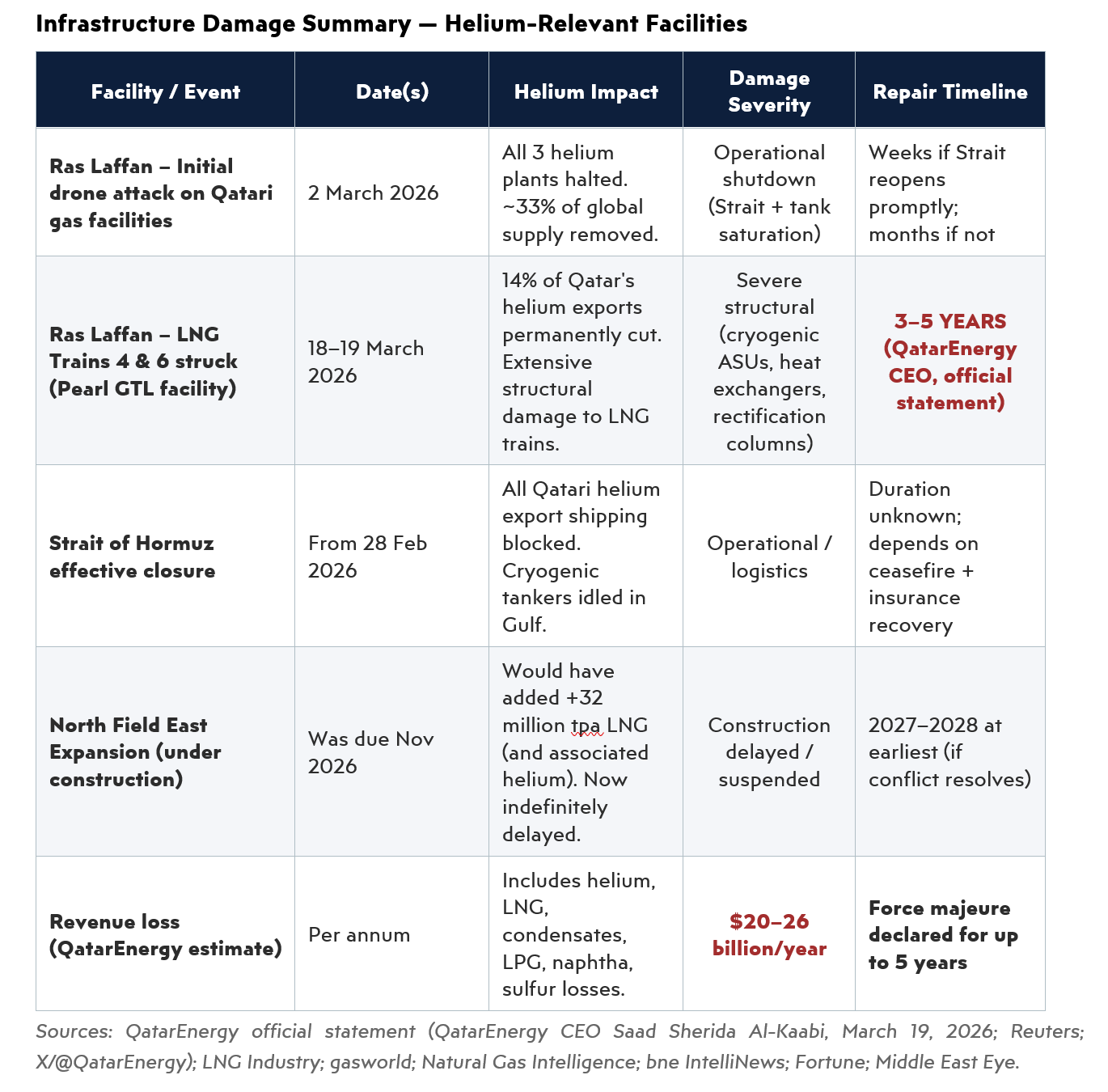
Two weeks after the ceasefire was announced, crude pulled back to something resembling its pre-crisis level, equity markets rallied past their 200-day moving averages, and financial commentary shifted its framing from “escalation” to “resolution.” Somewhere underneath the celebration, QatarEnergy’s CEO was confirming publicly that the missile strikes of March 18 and 19 damaged the cryogenic equipment at Ras Laffan so severely that full repair will take three to five years and cost up to $26 billion.
Three to five years. No diplomat compresses that timeline. No ceasefire reverses it.
The supply shock is not coming. It is already here.
How We Got Here: The Santiago Capital Research Arc
If you’ve been reading this publication over the past year, none of what you’re watching in global technology supply chains right now is a surprise. It is the expression of a thesis built piece by piece...and our latest pro-level report Absolute Scarcity is where it sharpens into its most consequential form yet.
It started with a foundational observation. In our pro-level report National Interest and Deglobalization, published September 2025, we argued that the globalization era was ending...not cyclically, but structurally. Governments were deliberately trading cost for security, redundancy for optimization, and control for openness. The 1980-2020 era of frictionless global supply chains was not the new normal. It was the historical exception. We are returning to the rule.
Then, in two addition pro-level reports Empire by Code and Stablecoin Wars, we mapped how the dollar was not just defending its reserve status but actively extending it into programmable digital infrastructure. The same deglobalization logic that was fragmenting physical supply chains was simultaneously hardening the dollar’s structural position. These were not separate stories.
In The Backyard, published February 2026, we documented the rewiring of the Western Hemisphere in real time. American forces removed Maduro in under 48 hours. Two carrier strike groups were massing near the Strait of Hormuz. The energy choke point sequence that had been theoretical in prior papers was becoming operational. The U.S. was reasserting control over who transits the most critical arteries of global commerce...and under what conditions.
In The End of Peacetime Portfolios, published March 2026, we made the investment implications explicit: the toolkit most institutional investors are using to manage tail risk was built for a world that is disappearing. Long-volatility strategies, the 60/40 portfolio, the assumption that shocks resolve toward prior equilibria...all of it calibrated for a world where institutional architecture guaranteed mean reversion.
And in The Last Ships, published April 8, we documented how a Hormuz energy shock cascades into a food crisis via the fertilizer supply chain, operating on a 6-to-9 month biological transmission lag that markets structurally cannot price.
Absolute Scarcity is the fourth simultaneous shock. And in structural terms, it may be the most dangerous of all four.
Why the Helium Shortage Is a Technology Story, Not an Energy Story
Here’s the thing most coverage of the Hormuz situation is not saying out loud.
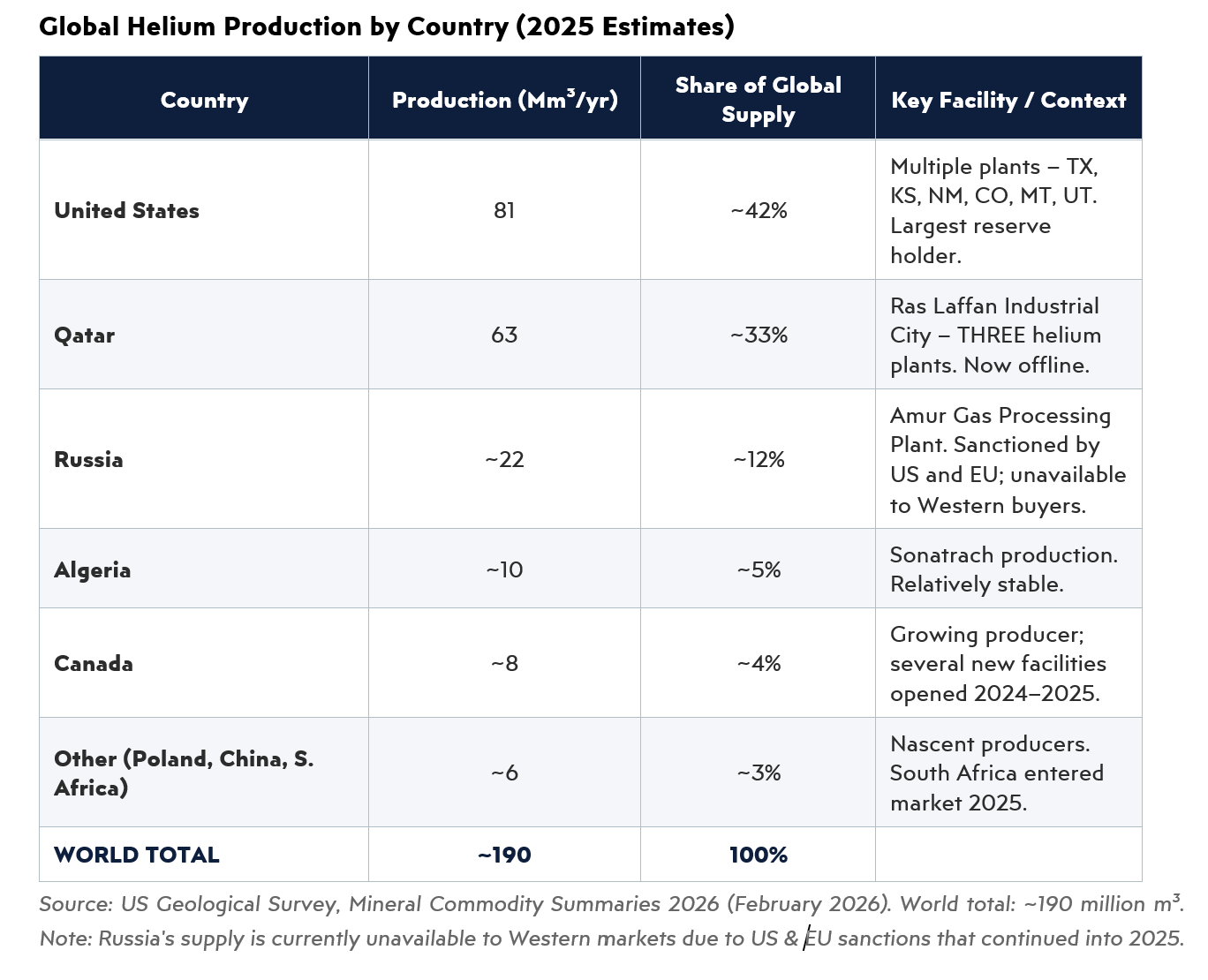
Qatar’s Ras Laffan Industrial City is not just an LNG facility. It is the world’s single largest helium production hub. The Persian Gulf supplies approximately one third of global helium. And helium does something no other substance on earth can do...it remains liquid close enough to absolute zero to cool the superconducting magnets in every MRI scanner in operation anywhere on the planet, to maintain the near-vacuum conditions inside every extreme ultraviolet lithography machine producing advanced chips, and to sustain the millikelvin temperatures required to keep qubits stable in quantum computers.
It cannot be synthesized in a laboratory. It cannot be meaningfully recycled at scale in most applications. Once released into the atmosphere, it escapes permanently into space and cannot be recaptured.
It’s not that the energy shock isn’t real. It is. It’s just that the energy shock is the story markets can see. The helium shock is the story they can’t. For applications below 20 Kelvin, helium is not one option among several. It is the only option.
According to the U.S. Geological Survey, approximately 75% of global helium supply comes from just two countries: the United States (42%) and Qatar (33%). Losing Qatar’s share, even temporarily, removes one third of the world’s supply of a material for which no substitute exists.
And unlike oil, there is no strategic helium reserve system comparable to the IEA’s emergency oil stockholding mechanism. The U.S. Federal Helium Reserve was privatized and wound down under legislation passed in 1996 and 2013, with final assets sold to a private entity in January 2024.
A private corporation, Linde plc, now holds what functions as the world’s de facto strategic helium reserve. That a private company occupies this role has no parallel in any other critical material of comparable strategic importance.
The globalization era systematically underpriced strategic vulnerability in favor of efficiency. The privatization of the Federal Helium Reserve is a textbook example of that error. The consequences are now visible in real time.
The Three-to-Five Year Problem No Ceasefire Can Fix
This is the part that financial commentary has consistently failed to internalize.
The operational shutdown of Qatar’s helium production when the Strait closed was bad. That part is reversible. When LNG storage tanks at Ras Laffan filled to capacity and production had to halt, helium extraction halted with it...because helium is extracted as a byproduct of natural gas liquefaction, not as a standalone process. When tankers can sail again, production can restart.
But the missile strikes of March 18 and 19 are a different category entirely.
QatarEnergy CEO Saad Sherida Al-Kaabi has confirmed publicly that LNG Trains 4 and 6 suffered extensive structural damage to cryogenic distillation equipment, aluminum plate-fin heat exchangers, and rectification columns that operate with temperature differentials of as little as one to two Kelvin. These components are manufactured in specialized workshops in Germany and China, shipped as large pre-assembled modules, and commissioned over months-long installation cycles.
Repairs are expected to take three to five years. Cost estimates run from $20 to $26 billion. The North Field East expansion project that would have added 32 million tons per annum of LNG capacity, along with proportionally expanded helium production, has been suspended indefinitely.
That timeline does not change when a ceasefire is announced. It does not change when the Strait reopens. It does not change when the S&P prints fresh highs.
It is a function of physics, engineering, and manufacturing lead times that no diplomat can compress.
The same people who said the Strait would never close are now saying any reopening means this resolves quickly. The first claim was wrong. The second deserves the same scrutiny.
What the Full Report Covers
Absolute Scarcity is our latest pro level report and the most detailed analysis this publication has produced on the fourth supply shock markets are not pricing. It maps the structural vulnerabilities that made a helium shock inevitable in any sustained Gulf disruption, documents the precise infrastructure damage inflicted on Ras Laffan and its multi-year repair timeline, and traces the cascade through the industries that define the next decade of economic and military competition.
It walks through the regional exposure gradient in detail. Taiwan imports 69% of its helium from Gulf states. South Korea imports 55%. TSMC, Samsung, and SK Hynix...the companies that produce the advanced logic chips and high-bandwidth memory on which the entire AI infrastructure buildout depends...are concentrated in the two nations with the highest helium dependence on the Gulf, and they hold inventory buffers that industry reports suggest exhaust around June 2026.
It documents the convergence of the helium shock with a pre-existing memory chip shortage driven by surging AI data-center demand, the compound vulnerability that has no recent precedent, and the specific mechanical reason that hundreds of billions in planned AI infrastructure investment was written without helium supply risk as a variable.
It assigns scenario probabilities to short, prolonged, and structural disruption paths, each carrying different portfolio implications. It maps the long case (North American helium producers, emerging producers in Tanzania and Canada and Australia, helium recycling infrastructure), the short case (semiconductor equipment manufacturers and AI infrastructure companies whose forward earnings assume uninterrupted Asian fab throughput), and the single most powerful relative trade expression of the thesis.
The base case for most institutional investors today is still, functionally, a bet that this resolves quickly and completely. Given what the report documents, that bet deserves to be made consciously, with clear eyes, and with a full understanding of what losing it would cost.
The cost of carrying the right exposures in a world that resolves quickly is modest. The cost of being incorrectly positioned in a world where the base case plays out is not modest.
The scoreboard at the end is what counts. And right now, the most important numbers on that scoreboard are not on any screen in any trading room in the world.
They are evaporating into space. Let’s dig in.